
AIKA Representatives Explore Ireland’s Experience with Cyclical Institutional Evaluation
Back to news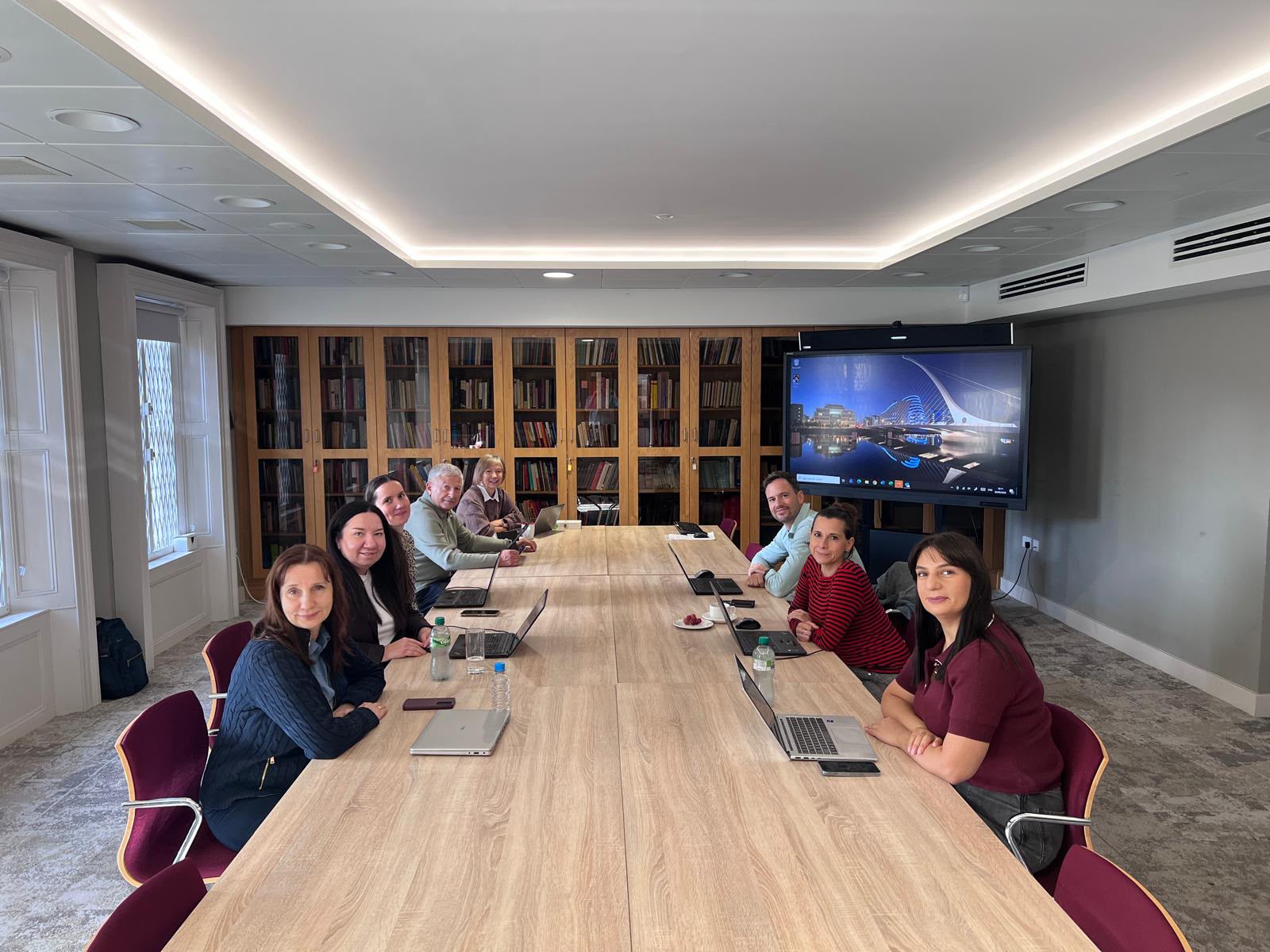
From 28 to 30 September, representatives of the Quality Agency for Higher Education (AIKA) visited Quality and Qualifications Ireland (QQI), Ireland’s quality assurance agency for higher education, to learn about the Irish approach to organising cyclical institutional evaluations. Representatives of the Slovenian quality assurance agency NAKVIS and the Armenian quality assurance agency ANQA also took part in the visit, providing an opportunity to exchange experiences among the four countries.
Established in 2012 through the merger of four organisations active in the fields of education and qualifications, QQI has a broad remit. In addition to its role in higher education quality assurance, it serves as Ireland’s ENIC/NARIC centre and acts as the national coordination point for the qualifications framework, similarly to the Academic Information Centre (AIC) in Latvia.
In Ireland, cyclical institutional evaluation, known as CINNTE, has been implemented since 2017. Its purpose is to assess the effectiveness of higher education institutions’ internal quality assurance procedures. The process covers both public and independent or private higher education institutions. While a common assessment methodology is used, separate guidelines have been developed for public institutions and for independent and private institutions.
In addition to institutional evaluation, all study programmes offered by independent and private higher education institutions undergo validation. This is a formal process of evaluating and approving programmes to ensure that they meet the requirements of the Irish National Framework of Qualifications (NFQ).
Between external institutional evaluations, QQI monitors institutions through two mechanisms – annual quality reports and biennial quality dialogue meetings with higher education institutions.
During the visit, AIKA representatives also learned about other aspects of the Irish higher education system, including the National Student Engagement Programme, the National Framework of Qualifications and the work of the National Academic Integrity Network. Discussions also covered current developments at QQI and its experience with generative artificial intelligence, including its use in preparing overviews and analytical reports. Particular attention was paid to QQI’s experience in implementing the European Approach for Quality Assurance of Joint Programmes and applying the European Degree Quality Label.
The exchange was particularly valuable given the developmental focus of QQI’s institutional evaluation process. This approach is based on the premise that higher education institutions have sufficiently mature internal quality assurance systems to address compliance with formal requirements themselves, allowing external evaluation to focus primarily on identifying opportunities for further development and improvement.
At the same time, QQI representatives emphasised that, even in a relatively mature higher education system, institutions vary in their level of development and in the maturity of their internal quality assurance systems. Smaller institutions face particular challenges and therefore require support measures tailored to their specific needs.
Ireland’s experience offers valuable insights for Latvia as it prepares to introduce cyclical institutional accreditation. It demonstrates that effective quality assurance requires not only evaluation against established requirements, but also support mechanisms for institutions’ internal quality assurance systems, with approaches tailored to each institution’s specific needs and level of maturity. The experience and insights gained will be utilized within the project “Implementation of Cyclical Institutional Accreditation in Higher Education” (No. 4.2.2.6/1/25/I/001) to refine the institutional accreditation methodology, its implementation approach, and the quality assurance processes associated with the new accreditation model.

